| Some Background Information About The Indian Star |
The Indian Star Tortoise (Geochelone elegans) has to be one of the most beautiful tortoises in the world. I fell in love with them at first
sight some years ago and was fortunate to be able to buy a group of young breeding-sized adults in 2001.
Everything I have researched about them leads me to believe that mine are the larger more colourful race that originate from Sri Lanka and
my adults bred, and I hatched my first babies in 2002. This has been an annual event since and I am currently the most successful UK breeder
(only a few people have managed to breed Indian Stars to date) of this wonderful tortoise and one of the top Indian Star breeders in Europe.
I sell my babies at a minimum of twelve weeks of age and a minimum weight of 40g. In my 15 years (and counting) of experience they will thrive for their new owners,
some of who have never kept a tortoise before. Being a tropical species they require all year round heat and must be segregated from other tropical
species and particularly the Mediterranean species, as the latter carry pathogens against which the Indian Star has no resistance.
They can be maintained in excellent health (and will likely breed) in indoor accommodation all year round and they eat much the same as the Mediterranean
species.
This is why I can recommend my Indian Star youngsters to you and have total confidence that they will thrive in your care - even if you have never
kept a tortoise before, so don't be put off by the conflicting advice you may have found on the internet and elsewhere - they really are well worth
the effort and I will make sure you have everything you need for them to lead a happy and healthy life in your home.
I am very happy for my 'new owners' to contact me by phone or e-mail to ask any questions they need to ask about their new acquision.
This is an ongoing service for all my customers. I get regular e-mails from all around the world requesting information about how to care for Indian Stars from places
as far afield as the USA, The Philippines, mainland Europe, Australia and even India and Kuala Lumpur in Malaysia.
E-mail me for a comprehensive free care-sheet written by myself from over 15 years of experience with this beautiful tortoise.
(If the link doesn't work, please use info@startortoiseuk.co.uk)
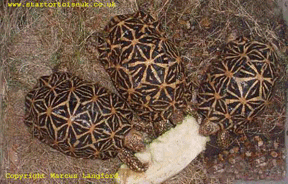
Three of my female Indian Stars 'dining' - this photo shows the beautiful 'star' pattern on their carapaces which gives them their name.
|
The Indian Star Tortoise is a relatively rare species and is (on paper at least) totally protected in the wild and its' export
from its home range of Sri Lanka, India, and Pakistan is prohibited, although animals of dubious origin (suspected wild-caught)
are still available via dealers in Europe and undoubtedly do reach the UK.
It is all the more vital to buy only genuine captive-bred animals for the sake of conserving this species and enabling populations
to recover in the wild.
As an example of what is happening out there a shipment of 400 wild-caught Indian Stars bound for Europe was seized in early 2006.
|
| An Ideal Size For Life Indoors |
Because of its relatively modest adult size (none of my adult females exceed 3kg in weight and 33cm in length and are likely in the region of 27 years old) the Indian Star is
probably the only readily available tropical tortoise suitable for long-term indoor accommodation.
Neither of its cousins - the Leopard Tortoise (Geochelone pardalis with a typical adult size in excess of 45cm in length and
over 15kg in weight) and African Spurred or Sulcata Tortoise (Geochelone sulcata, typical adult size 83cm in length and 105kg!
in weight) will be small enough to keep indoors as adults and will require their own shed/greenhouse complex not to mention
several people to actually lift them!!
You should bear this in mind when you see baby Leopard and Sulcata tortoises offered for sale in shops and on the internet -
both these species are pretty as babies but rapidly attain an unmanageable size and purchasers are seldom made fully aware of
their adult requirements when they are sold these 'cute' babies.
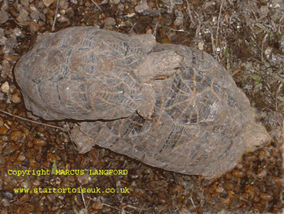
The creation of baby Star tortoises starts with 'friendly' adults! Photo taken
23-11-2006 Eggs will be laid approximately 3 months later.
|
|
| The Law Relating To Indian Star Tortoises |
ATTENTION
As from 14.12.2019 international law has been updated and tightened to reduce illegal trafficking in Indian Star tortoises and give them total legal protection in the wild.
It is now a legal requirement that every Indian Star Tortoise sold in the UK and throughout Europe, whatever its origins, must be supplied with an Article 10 Exemption Certificate
issued in the UK by DEFRA and I am pleased to say that all my Indian Star babies and older youngsters come with the correct paperwork issued in my name as the breeder.
If you are offered any Indian Star tortoise or are intending to buy one which the seller is unable to supply with an Article 10 exemption certificate you will not only be breaking
the law, buying an illegal animal, but also you will not be legally in possession of that tortoise.
This update in the law reflects the ongoing eradication of wild populations by the activity of unscrupulous traders and illegal smuggling and underlines the importance of knowing that the Indian
Star you are thinking of buying is a genuine captive bred animal - which all mine are.
If you require clarification you should contact DEFRA whose details are
Animal and Plant Health Agency (APHA)
UK CITES Management Authority, Centre for International Trade - Bristol
Deanery Road
Bristol
BS1 5AH
Tel: 0117 372 3700
Fax: 0208 415 2510
Email wildlife.licensing@apha.gov.uk
|
The Tortoise Trusts' "Practical Encyclopedia of Keeping and Breeding Tortoises and Freshwater Turtles" was published in 1996
and states that the Indian Star Tortoise "are not a particularly easy tortoise to induce to breed (or even mate) in captivity".
Clearly this is no longer the case as I have proved annually since 2002 and this book is now over 10 years out-of-date. Most
other books have very little information on Indian Stars and I have had to find out most of what I know for myself.
For up-to-date information the best source would appear to be me.
|
| Is The Indian Star A Delicate Tortoise? |
There seems to be a 'myth' that the Indian Star is a delicate tortoise and is difficult to keep, and this really originates from
the 1960's and 70's when the only available Indian Stars were imported direct from the wild and suffered chilling and subsequent
infections during their long journey from Asia to the UK. As a result few survived for very long once sold by shops in the UK.
My own experience is that my captive-bred Stars are straightforward to keep, very undemanding and have never caused me any health
problems - these are the 2000's after all and the 60's and 70's are now a very long time ago.
However the same is not true of imported Indian Stars and I have had e-mails from people who have bought imported Indian Stars
from dealers which have subsequently become sick, sometimes several months after purchase, requiring expensive visits to the vets
for respiratory tract infections and also - worryingly, intestinal worm infestations.
This is a common outcome of the importation process (for the reasons outlined in my 'the street-wise guide to the workings of the
tortoise trade' below) and can be simply avoided - by purchasing genuine UK - captive-bred Indian Stars direct from the breeder.
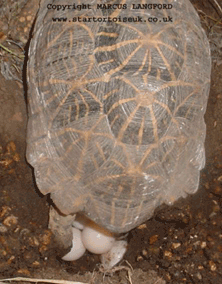
One of my adult female Indian Stars nesting.
Photo taken early 2006.
My females have laid clutches ranging in size from
1-8 eggs (this clutch was 6 eggs). Laying takes place
from late afternoon onwards and is most often completed after dark.
|
|
My baby Indian Star tortoises hatch after a minimum of 97 days incubation (although I have had the odd one take up to 134 days!) and emerge from the egg with a large yolk sac attached which is absorbed over several days in the incubator.
Once this has been absorbed I swab the remaining 'scar' clean with Betadine antiseptic using a cotton bud and transfer them to their terrarium where they soon start feeding.
Around 6 - 8 weeks after hatching they are all feeding enthusiastically, growing in both size and weight in a normal manner, and are ready for a new home.
Their hatching weight is typically around 17g at birth. By eight weeks old they have already grown to nearly 30g and are approaching the size of a ping pong ball.
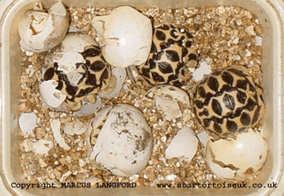
A clutch of four (look hard!) of my Indian Star babies hatching (photo taken mid 2006).
Hatching takes place after a period of 107
days or more in the incubator. |
|
|